
13th March 2015 By Open Contributing Writer for Wake Up World It is absolutely NOT my purpose to spread fear with regards to the very challenging situation Humanity is beginning to face. Quite the contrary, in confronting the truth of what’s really going on, we can confront those limiting fears that may hold back our evolution. Living…
Monthly Archive: March 2015
Permanent link to this article: https://news.truthjuice.co.uk/index.php/the-growing-global-water-crisis/
Meet the giant ‘lobster’ that roamed Earth’s primeval oceans


An international team of archaeologists has discovered a
giant inhabitant of Earth’s primeval oceans that would have dwarfed
all others.
Aegirocassis benmoulae was a two-metre-long
lobster-like sea creature, which had a long segmented body and
flaps on its belly that it used to get around.
By: Duncan Geere,
Permanent link to this article: https://news.truthjuice.co.uk/index.php/meet-the-giant-lobster-that-roamed-earths-primeval-oceans/
How to keep an old version of Spotify

Spotify’s most recent update is rolling out, which removes quite
a lot of handy features — but there’s a clever way to get them
back.
Not only does the latest version of the desktop software
get rid of support for third-party apps like equalisers, but
reports on the Spotify forums suggest that it also removes the
ability to search within playlists and minimise the application to
the system tray.
Representatives of the company say that the latter two features
will return in a subsequent update, but that’s not much use for
people using the software right now.
By: Duncan Geere,
Permanent link to this article: https://news.truthjuice.co.uk/index.php/how-to-keep-an-old-version-of-spotify/
Hot water on Saturn’s moon could harbour life

An analysis of cosmic dust found in orbit around Saturn points
to evidence that its icy moon Enceladus has hydrothermal
activity, which could harbour life.
The 500-kilometre diameter moon is covered with ice, but in 2005
the Cassini probe spotted plumes of ice and water vapour jetting
out of fractures at its south pole. The plumes were found to be
rich in sodium salt, meaning that liquid water has been in contact
with rock somewhere below the icy surface, and subsequent
gravitational measurements confirmed that there’s a
ten-kilometre-deep ocean hidden under 40 kilometres of ice.
By: Duncan Geere,
Permanent link to this article: https://news.truthjuice.co.uk/index.php/hot-water-on-saturns-moon-could-harbour-life/
How do you actually make a GM tomato?
So, I think we’ve all seen this type of image from anti-GMO activists:

The irony is that this is so completely divorced from what one actually does to modify a tomato, or indeed any plant, that it only serves to polarize. Also, it allows people who study genetics to immediately identify someone with absolutely no knowledge in the area of genetics, or genetic engineering.
So how is it really done?
Well, there are a couples ways. One of the most common, and classic, is using Agrobacterium tumefaciens. This bacteria has the special ability to take a certain part of its DNA (TI plasmid) and insert it into plants, and have this same DNA gain access to the nucleus. It doesn’t work on every species or family, but it works on quite a few, including Solanum (which includes potatoes and tomatoes). When used, it is applied primarily to female reproductive cells, allowing the plants to pass it onto the next generation.

The most famous way is probably using a “gene gun,” which also leads to a random incorporation of the added DNA. Remember that prior to ever being reproduced, all GM crops are analysed on a genetic level to figure out not only how many copies of the added gene are there (they only take clones that have a single copy), but also to determine in which clones there was no interruption of normal genes.

One of many methods: using a “gene gun”
Similar to when using the gene gun, we can also otherwise modify “baby” cells and then encourage them to turn into plants that we can breed. We don’t need to use a gene gun to do this, we can actually do this using electroporation. This is where we use an electrical pulse to allow the desired DNA to enter the cell, this is most famously used with bacteria but it also works on plant and even animal cells.

How electroporation works
The initial gene insertion pretty much always carries a selection or screening marker, to help scientists know which of the resulting colonies they want to investigate and multiply. This can take the form of antibiotic resistance or of an enzyme allowing a specific visible metabolic reaction. Without this, scientists wouldn’t know which plant/animal cells to continue working on: it verifies the existence of the inserted material.
 The next step is an obligatory step in modern GE: removing the selection marker from the transgenic organism, leaving simply the desired inserted sequence at a position that doesn’t interrupt another gene. Scientists enable this by including restriction sites around the selection marker, which allows this alone to be removed through a Cre/lox or FLP-FRT type system.
Now, after the insert has been verified, the selection marker removed, and the presence of the desired gene has been verified again (using PCR), they are ready to start breeding the clones and testing for health and environmental impact. Unlike the crops resulting from random mutations used in both conventional and organic, the mutations and health consequences of a GM crop have to be very thoroughly defined and tested.

On average, it costs over $130,000,000 and 13 years to bring a GM crop to market, which is over a hundred million more dollars and 13 years longer than it takes to introduce a new organic or conventional crop created from blasting the seeds with radiation.
Since GM does not work with completely random mutations, where do their genetic changes come from? Well, there are actually a LOT of ways to modify proteins, but the general process looks something like this:
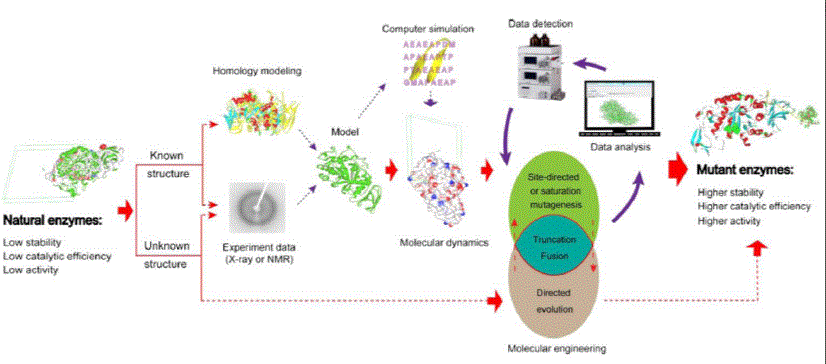
The fact is that if you thought that GMOs were untested, and created using “hormones” and needles whatsoever, you have been duped. There is a conspiracy relating to GMOs, but it isn’t about poisoning you or even “owning” the food supply (literally all crops can be patented, including non-GM), but it has to do with distracting consumers from understanding where the different seeds come from.
The post How do you actually make a GM tomato? appeared first on Exposing The Truth.
Permanent link to this article: https://news.truthjuice.co.uk/index.php/how-do-you-actually-make-a-gm-tomato/
December 18, 1966: Bear Mountain State Park, New York
I thought for fun and to change the tone of the discussion, I’d publish this analysis of a case that appears in the Project Blue Book files. The picture that appears in the files is so poor that it is nearly impossible to see with a magnifying glass. Of course those who wish to see it could take a look at the Fold3 site found here http://www.fold3.com/image/6979057/ to look at the picture and good luck with that.
The Air Force, after a quick analysis, decided, “Photo: Hoax. Photo does not substantiate the witnesses’ description of alleged UFO.”
The quick description was that the object was long with a hump on its back. The color was silver to brown. The witness said that he didn’t know how big the object was, but thought it was big. He would later suggest that it was it was about twenty feet long. The object appeared to wobble and that it disappeared behind a fire tower on a 1320 foot hill.
The official report, which was gathered within days of the sighting in a telephone interview, revealed that there was a single UFO, there was no sound or exhaust and that it had no wings. The pictures were taken about dusk.
First Lieutenant Thomas A. Knutson was the investigating officer. He wrote, “The initial interview was by telephone. The pictures were received 1½ weeks after the call. A second interview (personal) was conducted after receipt of the photographs and Mr. [name redacted but is Vincent Perna, 23] furnished the negative.” Although it is unclear from the Project Blue Book file, Perna apparently took four pictures before the object disappeared.
This sighting would be of no real value, even with the photographs, except for the Air Force conclusion and Dr. J. Allen Hynek’s response to that conclusion. On February 20, 1967, the Air Force provided its solution to the case. On the official form, located in the Project Blue Book files, Douglas M. Rogers offered his opinion:
Examination of the negative has negated double exposure and/or retouching. The photographs appear genuine insofar as content is concerned, however, no satisfactory explanation could be made of the unidentified object. The object appears to be circular in planform, basically flat in cross section with a domed “superstructure.” The object appears to be situated beyond the foreground trees, indicating a diameter in excess of eight inches, and the relative clarity indicates it to be substantially nearer than the background trees. The object could have a diameter as great as two or three feet. No attempt at “panning” was indicated as evidenced by the sharpness of the general scene. The object exhibits some small degree of blurriness indicating motion, the direction of which could not be ascertained.
The report was approved by Major William L. Turner, who was the chief of the photo analysis branch and Wilber Price, Jr., who was the chief of the exploitation division.
Hynek thought that the conclusion was “completely unfounded and unjustified. He sent a letter to Major Hector Quintanilla, who was the Chief of Project Blue Book at the time. Hynek wrote:
Dear Major Quintanilla:
On re-examination I find no substantiation for the evaluation of hoax, particularly in view of the photo analysis report, No. 67 – 10, dated 20 February 1967, which contains no information upon which a hoax can be based. To the contrary, the report stated that close examination of the negative negated double exposure and/or retouching. The photographs appear genuine insofar as content; however no satisfactory explanation could be made of the unidentified object. The lack of a satisfactory explanation of the unidentified object does not constitute sufficient reason to declare a hoax. Further, the interviewed considers the witness to be a reliable source.
After examination of the print by myself and by Mr. Beckman of the University of Chicago, we feel that the original negative should be requested for further examination. Mr. Beckman, a qualified photo-analyst, disagrees with the photo analysis presented in the report as to the distance of the object. He points out that the depth of field extends much farther than indicated in the report. It will be noted, from the print, that the focus is poor in the entire periphery of the picture regardless of distance; only in the center of the picture is the focus good, and this good focus extends essentially to infinity. Consequently no judgment can be made as to the real size of the object, if this judgment is based on the quality of focus.
My recommendation is, therefore, that the evaluation be changed from hoax to unidentified.
The letter was signed by Hynek who was, at the time, their scientific consultant, but the recommendation wasn’t followed. The “Hoax” evaluation was left intact.
It could be argued, and in fact Hynek does say it, that “…the Air Force was not interested in finding out all of the possible facts – or a more thorough investigation might have been conducted.”
It could also be argued that by this time, that is early 1967, Hynek had jumped ship and was always in conflict with the Air Force. He has said that there was animosity between him and Quintanilla at that time. He might have argued with any evaluation the Air Force made.
But what about this Mr. Beckman? He isn’t employed by Northwestern University where Hynek works, seems to have no stake in the case one way or the other, and he apparently agrees with Hynek’s evaluation. Beakman offers a counter to what seemed to be a solid Air Force analysis that had no other mission than to evaluate a photograph of a flying saucer.
In the end, it seems like a case of picking a side and arguing the point. There is no evidence of tampering with the negative or the prints, so the conclusion that it is a genuine picture seemed to be confirmed. That evaluation, for those paying close attention, meant that no one had doctored with the print of the negative. But it did not mean that the object photographed wasn’t a small model suspended some distance beyond the nearest trees and the farthest. Given that the camera had a set focal length, there simply wasn’t enough evidence to make a positive determination so that both sides could make claims that were hard to justify.
There is one other point to this. In 1967, the University of Colorado was beginning their investigation of UFOs for the Air Force. It would seem that a photographic case that was only a few months old, would be of interest to that project. They could have talked to the witness; they could have evaluated the photograph and then would have been able to examine the camera. It was all very timely for them, but there is no evidence that they made the effort to do so. Maybe they took the Air Force conclusion as an accurate evaluation. Hynek’s letter wasn’t sent to Quintanilla until November. Given that, they might not have thought it was worth the effort to investigate for themselves.
Permanent link to this article: https://news.truthjuice.co.uk/index.php/december-18-1966-bear-mountain-state-park-new-york/
WIRED Awake: 10 must-read articles for 12 March

Your WIRED.co.uk daily briefing. Today, hot spring in
deep space, Twitter bans revenge porn, Alibaba makes big
Snapchat investment and more.
By: WIRED.co.uk,
Permanent link to this article: https://news.truthjuice.co.uk/index.php/wired-awake-10-must-read-articles-for-12-march/
Transhumanism: Beyond Good, Evil and the Ubermensch
Is it time for transhumanists to embrace a better metaphor?
The idea of the ubermensch, a being superseding ordinary humans, was promoted 130 years ago by philosopher Friedrich Nietzsche. Because it seems to describe the phenomenon of Humanity+, many transhumanists have adopted the concept if not the term itself. However, further investigation may convince others, as it has me, that the time has come to move beyond good, evil and the ubermensch to a better metaphor. The reasons are logical, ethical and pragmatic.
 As of this writing, Nietzsche is fifth most-mentioned philosopher on the world-wide web, and the only of the top five alive during the last 200 years.[i] Born in 1844, Nietzsche and his sister grew up under the control of women: his mother, grandmother and aunts. His father and grandfathers, all Lutheran ministers, all passed away by the time Nietzsche was five. After graduating from university, he taught philology and watched in admiration the rise of Bismarck and the German nation. Nietzsche rejoiced that German manhood had redeemed itself from its former reputation as ”gentle, good-hearted, weak-willed, and poetical fools.”[ii] Bismarck, in many ways, personified the powerful ubermensch Nietzsche began to glorify, after illness led him to retire from teaching in 1879. Nietzsche wrote his major philosophical works during the 1880’s, before he deteriorated into syphilitic lunacy.[iii]
Nietzsche’s work was wide-ranging, but we will focus here on two topics that seem to attract futurists in artificial intelligence. First is the concept of Will to Power, which Western progressives tend to interpret as sublimation of inner drives for the purpose of creativity. The second is the concept of the ubermensch, often translated as “superman” or “over-man”, which transhumanists see as a vision for the next generation beyond Homo sapiens.
Nietzsche disagreed with then-popular philosopher Arthur Schopenhauer, who identified the source motive for Life as the Will to Survive. Nietzsche points out that survival is not the supreme motive behind human endeavor. People will risk life for power. Hence, he concludes, the Will to Power, not just survival, is actually humans’ chief motive.
From an information perspective, the Will to Power, as described by Nietzsche, starts as an intention to minimize entropy and increase predictability. The information-based entity wants to reduce information outside itself and use resulting energy to maintain or increase its own information. For what could be riskier to information than lack of control over data integrity? Integrity of core data has to be the highest mission of any entity, virtual or real. Without such integrity, the entity transforms into a different image or lapses into a state of high entropy, with little information at all.
The energy spent by an entity to protect its data integrity will vary with the disparity between perceived threat of disturbance and baseline comfort zone. Autistics demonstrate this inverse relationship between predictability and perceived threat; they fail to perceive patterns in similar situations or object classes. If desks are out of place, an autistic child sees no similarity to yesterday’s classroom and has no idea what is about to happen. Aunt Jenny’s red VW and Peter’s old blue Ford have no commonality. The category of “car” takes her a long time, if ever, to conceive of.[iv] Without the ability to perceive pattern and subsume classes, autistics cannot predict. This unpredictability engenders the terror typical of autistic children.[v] The energy of their terror reflects the enormous disparity between threat and comfort zone.
Power-seeking, from an information point of view, is risk-taking to improve predictability, to reduce the perceived threat of data loss. Taking risks to achieve enormous power is just a bet that sublimating current survival needs temporarily will achieve greater predictability and survival in the future. It is the gaming strategy of someone who fears future loss of data integrity so much that he would rather risk dying than lack it. Thus, from an information perspective, power is not sought ahead of survival. Power is the energy made available by reducing external entropy to increase the likelihood of survival. If an entity considers overall odds for data integrity to be greater through a high-return, high-risk aggressive action, it will gamble. Is that gamble what Nietzsche meant by Will to Power?
This informational interpretation of power-seeking can only occur in an entity with memory, planning and other high-level cognitive skills. A baser interpretation of Will to Power, possible in more primitive organisms, is the more immediate reward people experience as a feeling of power. In human men, for example, both serotonin and testosterone levels surge from the primitive portion of the brain when they win dominance encounters.[vi] Information-wise, this is validation. Consequently, value is associated to the actions that led to chemical rewards from a power struggle.
Which sort of power-seeking does Nietzsche refer to when he espouses a new “scepticism of daring manliness, which is closely related to the genius for war and conquest…This scepticism despises and nevertheless grasps; it undermines and takes possession….It is the German form of scepticism, which, as a continued Fredericianism [after Frederick the Great] …has kept Europe for a considerable time under the dominion of the German spirit…”[vii] Perhaps Nietzsche meant both types of Will, the conceptual and the chemically induced?

Regardless, Nietzsche totally overlooked organisms’ need to increase predictability, as gained through scientific inquiry. While he freed himself from strictures of religion and dogma, he also cast aside the notion of an independent, objective reality. He predicted that future philosophers “will not be dogmatists. It must be contrary to their pride, and also to their tastes, that their truth should be truth for everyone.”[viii] Rather than welcoming a partnership with scientific inquiry, he protests: “after science has, with the happiest results, resisted theology…it now proposes in its wantonness and indiscretion to lay down laws for philosophy, and in turn to play the master…!”[ix]
Over time, Nietzsche fell increasingly ill; his mental faculties were deteriorating; colleagues often discounted his ideas. His sole hope for power was to influence young philosophers to “grasp at the future with a creative hand, and whatever is and was becomes … a means, an instrument, and a hammer. [Philosophers’] ‘knowing’ is creating, their creating is a law-giving, their will to truth is a Will to Power.”[x] Nietzsche disdained egalitarianism, garbed as democracy or as socialism.[xi] He felt it reduced everyone to the lowest common denominator. Whether Nietzsche or his sister wrote these words, published posthumously, they describe the concept of the ubermensch: “…such a morality, with the intention of producing a ruling caste – the future lords of the earth —must, in order to be taught at all, introduce itself as if it were in some way correlated to the prevailing moral law… to this end, a host of transitionary and deceptive measures must be discovered, and that the life of a single individual stands for almost nothing compared to the accomplishment of such lengthy tasks and aims…” The piece continues on to describe the nurturing of this “new, vast aristocracy based on the most severe self-discipline, in which the will of philosophical men of power and artist-tyrants will be stamped upon thousands of years….working as artists upon man himself!”[xii]
The idea of humanity recreating itself sparks the transhumanist movement. Progressive fans of Nietzsche ignore his calls for aggression and interpret the Will to Power as a call for self-actualization.
 But this interpretation might be an example that words do not send signals in a vacuum. Messages are deformed by environment and receiver. Those who truly wish to create a better future must consider the interaction of their messages with the patterns around them. What consequences followed the receipt of messages from Nietzsche?
This question should give pause to anyone tempted to resurrect the ubermensch. Nietzsche’s teachings were deployed for domination. Nietzsche’s sword, disguised as a “harmless walking stick”, ended up in Hitler’s possession.[xiii] The metaphor is difficult to escape. Nietzsche’s artistry, his creation, his philosophy, fueled some of the worst atrocities in the history of humankind.
Are we at such a different point in civilization that we believe that we can disperse god-like capabilities in a humane, democratic fashion touting the emergence of an ubermensch? What will be the message received? We need to admit that Nietzsche’s philosophy bifurcates society into in-groups and out-groups, regardless its intent. We need to seek a better vision, beyond good, evil and Nietzsche, to guide us into the future.
A Better Vision in Mandelbrot
Consider an information-based philosophy rooted in Benoit Mandelbrot’s fractal universe.[xiv] Therein, space is infinite; a milkweed seed can contain as much information as a solar system. Information grows in patterns within and without. Interactions transform, but need not erase. Is this not a better vision for a world of long life and plenty? Is this not a will to beauty beyond any proposed before? Will this not meet humankind’s urge to maintain and disperse pattern? What better sign that humankind has progressed than that we turn to a mathematician, rather than a philosopher, for direction?


References and Notes
[i] Most popular philosophers, Google search engine summary notes, 27 February, 2015. https://www.google.com/search?q=most+popular+philosophers&oq=most+popular+philosophers&gs_l=serp.3..0l3j0i22i30l7.40355.44092.0.44381.17.17.0.0.0.0.170.2453.0j17.17.0.msedr…0…1c.1.62.serp..0.17.2450.oftXoBdALfc
[ii] Nietzsche, Friedrich. Beyond Good and Evil, as translated by Helen Zimmern in The Philosophy of Nietzsche; Random House, New York, NY, US, 1927; paragraph 209.
[iii] Beardsley, M. Friedrich Nietzsche, The European Philosophers from Descartes to Nietzsche; Random House: New York, NY, US, 1960; pp. 802-803.
[iv] Grandin, Temple. 1996 Thinking in Pictures, Viking Press: New York, NY.
[v] Zajac-Gastgeb, Holly, Strauss, Mark and Minshew, Nancy. Do Individuals With Autism Process Categories Differently? The Effect of Typicality and Development, Child Development, November/December 2006, Volume 77, Number 6, Pages 1717 – 1729
[vi] Masters, Roger. Neurochemistry, Personality & Behavior, The Neurotransmitter Revolution: Serotonin, Social Behavior, and the Law; Southern Illinois University Press: Carbondale, IL; p 10.
[vii] Nietzsche, Friedrich. op cit., 6 We Men of Learning, paragraph 209.
[viii] ibid, 2 The Free Spirit, paragraph 43.
[ix] ibid, 6 We Men of Learning, paragraph 204.
[x] ibid, paragraph 211.
[xi] ibid, 5 The Natural History of Morals, paragraph 203.
[xii] Nietzsche, Friedrich. The Will to Power, translated by Anthony M. Ludovici in The Philosophy of Nietzsche; Random House, New York, NY, US, 1927; paragraph 960.
[xiii] Kohler, Joachim. 1999. Nietzsche and Wagner: A Lesson in Subjugation. Yale University Press: New Haven, CT, p 13.
[xiv]Mandelbrot, Benoit. 1977. The Fractal Geometry of Nature. WH Freeman and Company: New York, NY.
###
Jeanne Dietsch is a three-time tech entrepreneur and monitor of change, running for Board of Directors of H+. She was a columnist for Robotics and Automation Magazine from 2009-2012. Before she sold her intelligent mobile robot company in 2010, it (MobileRobots Inc) was the largest designer and manufacturer of research robots. Jeanne graduated with honors from Harvard Kennedy School of Government under the Seamans Fellowship in Science and Technology Policy in 2013. She founded Sapiens Plurum (“the wisdom of many”), to advocate for humankind-ness in an age of greed, complexity and human transformation.
Sapiens Plurum “The Wisdom of Many”
Blog: Saving Humankind-ness
The post Transhumanism: Beyond Good, Evil and the Ubermensch appeared first on h+ Media.
Permanent link to this article: https://news.truthjuice.co.uk/index.php/transhumanism-beyond-good-evil-and-the-ubermensch/
AP sues State Department, seeking access to Clinton records

The Associated Press filed a lawsuit Wednesday against the State Department to force the release of email correspondence and government documents from Hillary Rodham Clinton’s tenure as secretary of state.
The legal action comes after repeated requests filed under the U.S. Freedom of Information Act have gone unfulfilled. They include one request AP made five years ago and others pending…
Permanent link to this article: https://news.truthjuice.co.uk/index.php/ap-sues-state-department-seeking-access-to-clinton-records/
Wikipedia is suing the NSA over online spying

The nonprofit behind Wikipedia, the Wikimedia Foundation, is suing the National Security Agency and the Department of Justice over a government surveillance program. The suit challenges a program that collects data by tapping into the infrastructure, or backbone, the Web is built on.
“We are asking the court to order an end to the NSA’s dragnet surveillance of Internet traffic,” Wikipedia …
Permanent link to this article: https://news.truthjuice.co.uk/index.php/wikipedia-is-suing-the-nsa-over-online-spying/